
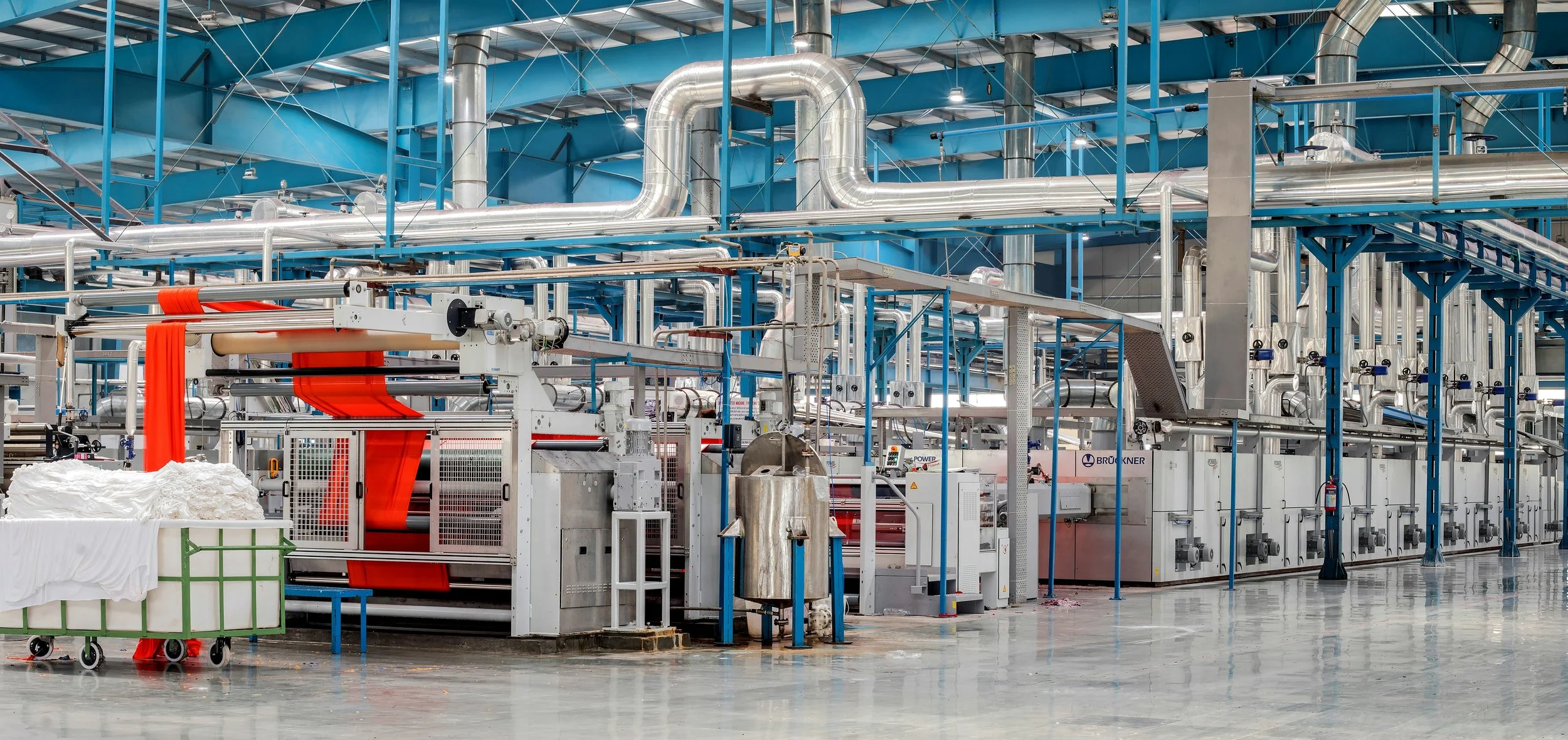
Textile finishing facility - Unsplash photo by Lait Kumar
For years, the UK's clothing reuse sector has been held up as a circular economy success story.
Every year, charities, local authorities, social enterprises and commercial collectors recover hundreds of thousands of tonnes of clothing. In so doing, they extend product life, generate charitable income and prevent valuable materials from being lost to disposal.
“…modern life is rubbish…
I’m holding on for tomorrow”
Blur, 1993
Yet beneath those impressive statistics lies an uncomfortable truth: the economic foundations that have supported textile reuse for decades are beginning to fail.
Prices paid for collected clothing have fallen sharply
International markets absorbing surplus textiles are becoming increasingly selective
Reuse organisations face rising operating costs
The quality of clothing entering the system continues to deteriorate, as volumes increase
These are not isolated market fluctuations. They are warning signs that the UK clothing market has become fundamentally unbalanced.
More importantly, they expose a much larger issue.
Britain is increasingly importing products that are designed to become waste.
Hidden costs of cheap fashion
Consumers have understandably welcomed lower clothing prices over the past two decades. However, the true costs have simply been transferred elsewhere.
Ultra-fast fashion has transformed clothing from a durable consumer product into something increasingly disposable. It is estimated that 40% of clothing manufactured is never even sold or worn. And in the UK, 1.4 million tonnes of clothing is sold each year… with about the same amount thrown away.
Many garments now enter the reuse system after only a handful of wears. Fabrics are lighter, fibre blends more complex and construction quality significantly lower than previous generations of clothing.
This matters because reuse only works when products retain value.
A well-made jacket might be worn by five or six owners over twenty years; a poorly manufactured synthetic top may have little resale value after its first owner.
Every low-quality garment entering the UK market creates an additional burden for charities, collectors, local authorities and recyclers.
The purchase price may have been low… the environmental and economic costs are not.
We are importing future waste
Successive governments have rightly sought to reduce plastic pollution, improve packaging design and encourage repair of electrical products.
Yet clothing has largely escaped the same level of scrutiny.
Millions of garments enter the UK each year with little consideration of how long they will last, whether they can realistically be repaired or whether their constituent fibres can ever be economically recycled.
In effect, Britain has created a market where the easiest products to sell are often the hardest products to recover.
The result is predictable.
Reuse organisations spend increasing amounts of money sorting products that have little commercial value
Local authorities face rising disposal costs
Advanced recyclers struggle with complex fibre blends
Consumers unknowingly purchase clothing that may have little useful life beyond a single season
This is not simply a waste management issue. It is an industrial policy issue.
Export safety valve is closing
For decades, the economics of textile collection have relied upon export markets.
Higher-quality clothing remained within the UK, while lower-grade materials were exported for resale overseas. That model is becoming progressively less reliable.
Many importing nations are understandably questioning whether accepting ever-increasing volumes of second-hand clothing genuinely supports their economies, or merely transfers another country's waste problem. We’ve seen this - and the understandable reaction by importing nations - before, for packaging and electrical equipment.
At the same time, regulators are placing greater emphasis on ensuring exported textiles are genuinely reusable - and destined for reuse - rather than ‘waste’ disguised as reuse.
These developments should not be viewed negatively.
Instead, they should encourage Britain to develop higher-value domestic markets for the materials it already possesses - for reuse, repair and fibre-to-fibre recycling where economic activity takes place within Britain, less is imported and less is exported.
Our unwanted clothing should increasingly become a resource for British businesses rather than a commodity shipped overseas.
Europe is treating textiles as strategic infrastructure
Across Europe, policymakers are beginning to recognise textiles as critical industrial resources rather than disposable consumer goods.
Digital Product Passports, Extended Producer Responsibility, Ecodesign legislation and restrictions on destroying unsold clothing all share one objective: keeping materials circulating within domestic economies for as long as possible (and encouraging importers to consider the quality of their products, too).
The UK should view these developments not simply as environmental regulation but as cost-effective industrial strategy.
Every kilogram of textile material successfully reused, repaired, remanufactured or chemically recycled represents retained economic value.
Every tonne exported represents lost opportunity - and more cost incurred.
Britain should build a domestic circular textile economy
The UK possesses world-leading expertise in materials science, chemistry, digital technology and advanced manufacturing.
It has internationally respected universities
It has innovative recycling companies
It has globally recognised fashion brands
It has an established reuse sector
Yet much of the value contained within discarded clothing still leaves the country.
Instead of exporting used textiles and importing replacement garments, Britain should be developing integrated domestic supply chains capable of extracting the optimum life and maximum value from every fibre.
Quality clothing should be reused. Damaged garments should be repaired. Unwearable textiles should be remanufactured wherever possible.
Materials that genuinely reach end-of-life should be chemically or mechanically recycled into virgin-quality feedstocks capable of supporting British textile manufacturing.
This is the essence of a true circular economy. In isolation, a bit of reuse or a bit of recycling with a large dollop of hoping for the best does not make a circular economy.
Stop rewarding poor-quality
Perhaps the most politically difficult question is also the simplest:
Should Britain continue allowing unlimited imports of clothing that has little realistic prospect of surviving a second owner?
The answer should be no.
Just as safety standards transformed the automotive industry and minimum energy standards improved household appliances, clothing should increasingly meet basic expectations for durability, repairability and recyclability.
Products designed for longevity create stronger resale markets.
They generate higher charitable income
They reduce waste management costs
They improve resource efficiency
Most importantly, they reward responsible manufacturers rather than those competing solely on price, and more often than not, landing the cost at end of life on the taxpayer.
Public procurement can lead the transition
The public sector is one of the country’s largest users and procurers of textiles. The NHS alone employs more than 1.5 million people, while defence, police, fire and rescue services and local authorities collectively employ hundreds of thousands more who require uniforms, workwear and PPE. National police uniform procurement alone is valued at around £500 million over ten years. Alongside this sits the school uniform market: government research puts average expenditure on uniform and PE kit at around £382 per pupil.
Together, publicly procured and publicly specified textiles represent a market comfortably worth hundreds of millions of pounds every year - and, when school uniform expenditure by families is included, potentially several billion pounds.
These purchasing decisions should actively support British circular manufacturing.
Contracts should encourage durability, specify repairability, reward recycled content. They should require transparent material information through Digital Product Passports.
Most importantly, they should ensure products are designed with their next life already planned.
Government doesn't need to wait for EPR legislation to change the textile system. Through procurement specifications it can already require durability, repairability, take-back, reuse, recycled content, traceability/Digital Product Passports and fibre-to-fibre recycling across some extremely large clothing markets.
The role of innovation
Innovation will underpin this transition.
Advanced fibre sorting
Artificial intelligence
Digital Product Passports
Automated repair technologies
Fibre-to-fibre recycling
Polymer recovery
High quality, skilled jobs
New business models based upon leasing, repair and reuse
These are no longer theoretical concepts. They are rapidly becoming commercial realities. The countries that develop these industries first will capture the economic value that accompanies them.
Britain should intend to be one of those countries.
Time for a new national strategy
The UK needs a textile strategy that reaches beyond waste management.
One that recognises clothing as an economic asset rather than an environmental liability; that places domestic reuse ahead of export; that supports British remanufacturing.
One that encourages high-quality product design while discouraging the import of disposable clothing that simply shifts costs onto charities, local authorities and future taxpayers.
Above all, Britain must stop treating cheap clothing as cheap simply because the environmental costs appear somewhere else.
They do not disappear. Cheap is poor value for money with huge hidden costs.
These hidden costs merely arrive later… in collection costs, in landfill, in export costs, in overseas dumping, in public spending and in lost industrial opportunity.
A modern industrial strategy should therefore have three clear objectives:
Promote domestic reuse as the default option
Discourage imports of low-quality, short-life clothing that undermines circular markets
Rebuild domestic textile manufacturing using recovered British materials
The question facing the UK is no longer whether we can build a circular textile economy.
It is whether we choose to. For organisations such as Stuff4Life, the answer is clear. The technologies, the innovation and the market opportunities exist.
All that is now required is the policy ambition to match them.
___________
Sources and further reading:
WRAP - Textiles Market Situation Report 2024
WRAP - Post-Consumer Textiles Landscape Review
Environment Agency - Importing and exporting waste and non-waste textiles, June 2026
European Commission - EU Strategy for Sustainable and Circular Textiles / Ecodesign for Sustainable Products Regulation
Oxfam - research on global clothing overproduction and unsold garments
___________
For more information or to sign up for our newsletter, contact us.