

People matter, even in digital systems - Unsplash photo by Emilipothèse
Digital Product Passports are set to become an important part of the circular economy.
For textiles, the principle is compelling: better information about what a garment is made from, where it came from, what has happened to it and what should happen next. But it’s the people who care that make the difference.
But there is a risk that something fundamentally simple is made unnecessarily complicated.
For SMEs in particular, sophisticated RFID, NFC or proprietary tracking systems can mean significant investment in tags, scanners, software, integration and data management.
At Stuff4Life - the StaySafe Way, we're interested in technology - but we're even more interested in making circularity work.
And sometimes the humble barcode combined with people who care is a remarkably good combination.
Trace the garment - but look after it too
A barcode doesn't need to hold everything we know about a garment. It can simply provide the unique link between the physical item and its digital record.
Scan it when it enters service. Scan it when it needs some love. Record what happens next.
That fits naturally into the Stuff4Life - the StaySafe Way model:
Collect → Wash → Check → Repair → Reissue → Repeat
When garments are returned, they're collected, weighed and sorted. Suitable workwear is professionally washed and disinfected using StaySafe's specialist ozone-based process, inspected and repaired where appropriate. It can then be returned for reuse, while garments requiring a different route can be debranded, rebranded, repurposed or ultimately recycled.
Our existing service already records workwear by customer, weight and type and provides an audit trail of what was received and what happened to it.
Adding garment-level identification can make that increasingly powerful.
How many times has this jacket been through the laundry? Has it previously been repaired? How long has it remained in service? When was it reissued? And eventually, why was it judged no longer suitable for reuse?
That's useful data for sustainability. But it's also useful business information.
“Dancing to electro-pop
like a robot from 1984”
Arctic Monkeys, 2006
A Digital Product Passport can't inspect a jacket
There's another important part of traceability that can easily be overlooked: people.
Technology can identify a garment and retrieve its history. It cannot replace the experience of the person inspecting it.
Is the reflective material still performing? Can that damaged pocket be repaired? Is the garment sufficiently presentable to be reissued? Does it still meet the agreed standard?
Stuff4Life - the StaySafe Way combines digital traceability with physical quality control.
That distinction matters. Circularity isn't achieved by knowing where a product is. It's achieved by using that information to make the right decision about what happens to it next.
From barcode to passport - and fibre to fibre
Eventually every garment reaches the point where another wash or repair no longer makes sense. Our ambition is that this doesn't end the story.
Stuff4Life is developing technology to depolymerise polyester and recover its chemical building blocks, including recycled Purified Terephthalic Acid (r-PTA), so that they can ultimately be used to manufacture polyester again.
And through our role in the EU Horizon-funded AUTOLOOP project, we're working with partners on the bigger challenge: connecting advanced sorting, recycling, remanufacturing and traceability to help close the textile loop.
The long-term opportunity is therefore to follow something much further:
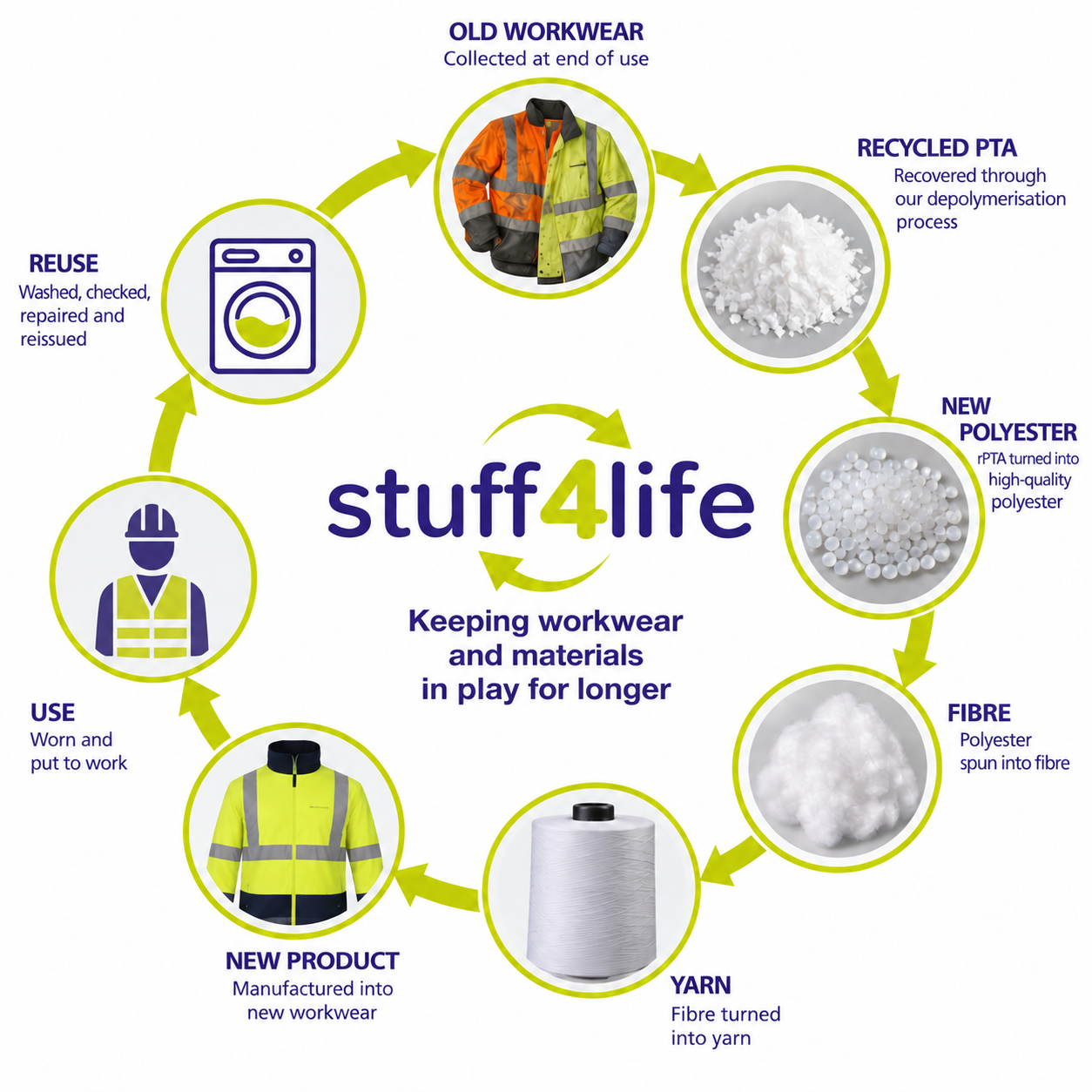
Fully circular workwear - our aim
That is where Digital Product Passports become really exciting. The passport ceases to be simply a record of a product and becomes part of the infrastructure that helps materials circulate.
Start simple. Build intelligence.
Our view is that businesses shouldn't have to wait for the perfect DPP system before taking action.
Start with what works. A barcode may be enough. Record the right information. Make sure the data is accurate. Combine it with proper inspection and quality control. Use it to extend garment life and understand why products eventually fail.
Then build greater sophistication as the technology, standards and business case develop.
Because for us, traceability isn't about creating more data.
It’s about knowing where your stuff goes: what you've got, where it is, what condition it's in, what has happened to it… and what the best circular decision is next.
That's Stuff4Life - the StaySafe Way: use technology where it helps, people where they matter, and keep products and materials in play for as long as possible.
For more information, contact us.